

Synopsis Sri Lanka is a civilizational state — consecrated to the Buddha Sasana for over 2,570 years. From King Pandukabhaya to King Dutugemunu, from Mahiyangana to Anuradhapura, this island was offered to the Buddha. The four Buddhas — Kakusandha, Konagamana, Kassapa, and Gautama — link Lanka to sacred continuity. Colonial powers called it Ceylon, but its true name is Lanka: one, indivisible, eternal. Article 2 declares unity, Article 9 gives Buddhism the foremost place, and the Sixth Amendment rejects separatism. Together, they are the shield of the Constitution, the guardian of the Sasana, and the eternal duty of the nation.
Sri Lanka is a civilizational state consecrated to the Buddha Sasana for over 2,570 years. From King Pandukabhaya to King Dutugemunu, from Mahiyangana to Anuradhapura, this island was offered to the Buddha. The four Buddhas Kakusandha, Konagamana, Kassapa, and Gautama link Lanka to sacred continuity. Colonial powers called it Ceylon, but its true name is Lanka: one, indivisible, eternal. Article 2 declares unity, Article 9 gives Buddhism the foremost place, and the Sixth Amendment rejects separatism. Together, they are the shield of the Constitution, the guardian of the Sasana, and the eternal duty of the nation.
Sri Lanka is not merely a republic born in 1948. It is a civilizational state consecrated to the Buddha Sasana for over 2,570 years. From the arrival of Mahinda Thera, this island was offered as a pujā to the Buddha. Kings such as Pandukabhaya, Devanampiya Tissa, Dutugemunu, Valagamba, Parakramabahu, and Parakramabahu VI reaffirmed this dedication. The Mahavamsa records how rulers saw their authority not as privilege but as guardianship of the Sasana. Therefore, the civilizational rights of this land are native, original, and sacred. They cannot be displaced by temporary politics, foreign agendas, or separatist myths.
From King Pandukabhaya who organized Anuradhapura, to King Devanampiya Tissa who received Mahinda Thera, to King Dutugemunu who fought to protect the Sasana, Sri Lanka’s rulers understood their duty. King Valagamba rebuilt temples after invasions. King Parakramabahu unified the Sangha to restore discipline. Each ruler saw his authority as guardianship, not privilege. The chronicles speak of four Buddhas born in this world: Kakusandha, Konagamana, Kassapa, and Gautama. Each Buddha’s dispensation touched lands across Oja Dveepa, Wara Dveepa, Manda Dveepa, and Sinhala Dveepa, but Sri Lanka was uniquely consecrated to Gautama Buddha’s Sasana. Sacred sites such as Mahiyangana, Thuparama, Ruwanwelisaya, and Sri Maha Bodhi are civilizational anchors linking Sri Lanka to the lineage of the Buddhas. Thus, Ceylon as colonial powers called it is not just geography. It is a sacred trust, a land offered to the Sasana.
The Portuguese came with the cross and the sword. They burned temples, destroyed manuscripts, and forced conversions. Yet the Sasana survived in the villages, protected by monks who carried the Dhamma in their hearts. The Dutch came with Calvinism, restricting Buddhist practice and undermining Kandyan traditions. Yet the Kandyan kings defended the Sasana, showing civilizational resilience. The British came with missionary schools, Christianization, and the destruction of Buddhist education. Yet Anagarika Dharmapala, Olcott, and the Buddhist Theosophical Society revived the Sasana. Article 9 is the fruit of that revival. It is the modern continuation of centuries of resistance.
The LTTE’s separatist war was not a struggle for rights; it was a war against civilizational truth. Prabhakaran’s ideology aimed to erase Sinhala Buddhist presence from the North and East. The LTTE attacked pilgrims, destroyed villages, and assassinated monks. They expelled Muslims from Jaffna, silenced Tamil leaders who opposed them, and terrorized civilians. This was not liberation; it was terrorism. The humanitarian war of the Sri Lankan Army rescued hundreds of thousands of Tamil civilians held hostage. The so‑called “Eelam country” collapsed under its own falsehood. It was never a nation, never a state, never a civilizational truth. It was a terrorist project, rejected by the Constitution, defeated by the Army, and exposed by scholars.
The Tamil diaspora speaks of Sinhala Buddhists as colonizers, oppressors, and chauvinists. They lobby in foreign capitals, spreading words that erase civilizational truth. Tamil leaders within Sri Lanka call temples in the North and East “colonization,” ignoring the chronicles that record ancient viharas in those lands. They demand federalism and power devolution beyond the Constitution. But Article 2 declares Sri Lanka a Unitary State. The Sixth Amendment criminalizes advocacy of secession. No meeting, no resolution, no speech can override this. The fake Eelam concept is not a right; it is a violation.
The diaspora’s revival of the Vaddukoddai Resolution (1976) and the LTTE’s separatist ideology is a direct violation of the Sixth Amendment (1983), which criminalizes advocacy of secession. Every attempt to stage Vaddukoddai‑style meetings in later years, whether through diaspora conferences, Tamil Nadu rhetoric, or separatist protests such as the so‑called “Black Day” in February 2026, is illegal in our motherland. These gatherings are not exercises of rights; they are violations of the Constitution and betrayals of civilizational truth.
The book Eelam Exposed by L.K.N. Perera dismantles the myth of Eelam with historical and legal evidence. It reveals the nakedness of Tamil politicians who misled their people with false promises of a separate state. It shows, with rare sources, that the Eelam concept is a fabrication. The chronicles, the foreign accounts, the archaeological record all prove that Sri Lanka is one, indivisible, consecrated to the Sasana. Scholarship and sacrifice together expose separatism as falsehood.
Anura Kumara Dissanayake speaks of protecting Buddhism, yet his earlier rhetoric treated Sinhala Buddhist nationalism as an obstacle. Lal Kantha insulted monks, condemned by the Asgiri Chapter. Harini Amarasuriya misrepresented the LTTE war as mere political gain, ignoring separatist violence. Tilvin Silva guided the JVP with Marxist secularism, yet now speaks of protecting Article 9. Maithripala Sirisena promised protection, yet allowed debates to dilute it. Chandrika Kumaratunga spoke of reconciliation while exploring secular frameworks. Ranil Wickremesinghe reassured Buddhists, yet earlier aligned with donor‑driven reforms. These are not genuine defenses of Buddhism. They are Trojan horses outward gestures for votes, inward concessions to secularism.
“No policy builder, politician, or external actor has any lawful right to bypass, dilute, or delete Article 9 — for to do so is not merely a legal violation, but a betrayal of Sri Lanka’s civilizational trust.”-Palitha Ariyarathna
Any attempt to abolish, bypass, or dilute Article 9 is a direct threat to the nation. The Buddha Sasana, and the Dhamma within it, must never be subjected to internal or external manipulation. All parties within the State, and all forces outside it, whether local or foreign, are bound to respect this sacred trust. To interfere with it is to commit an unlawful act, to betray the civilizational foundation, and to violate the rightful inheritance of the Bhikkhu, Bhikkhuni, Upasaka, and Upasika. This inheritance is eternal, and it is non‑negotiable.
Article 9 is eternal. Article 2 declares Sri Lanka a Unitary State. The Sixth Amendment criminalizes separatism. The humanitarian war defeated terrorism. Scholarship exposed the myth. Together they form the shield of the nation. The President must gather all separatist notes, all false demands, and ban them on the spot. For the Constitution itself has spoken: Sri Lanka is one, indivisible, and consecrated to the Sasana. This is the civilizational truth. This is the eternal duty.
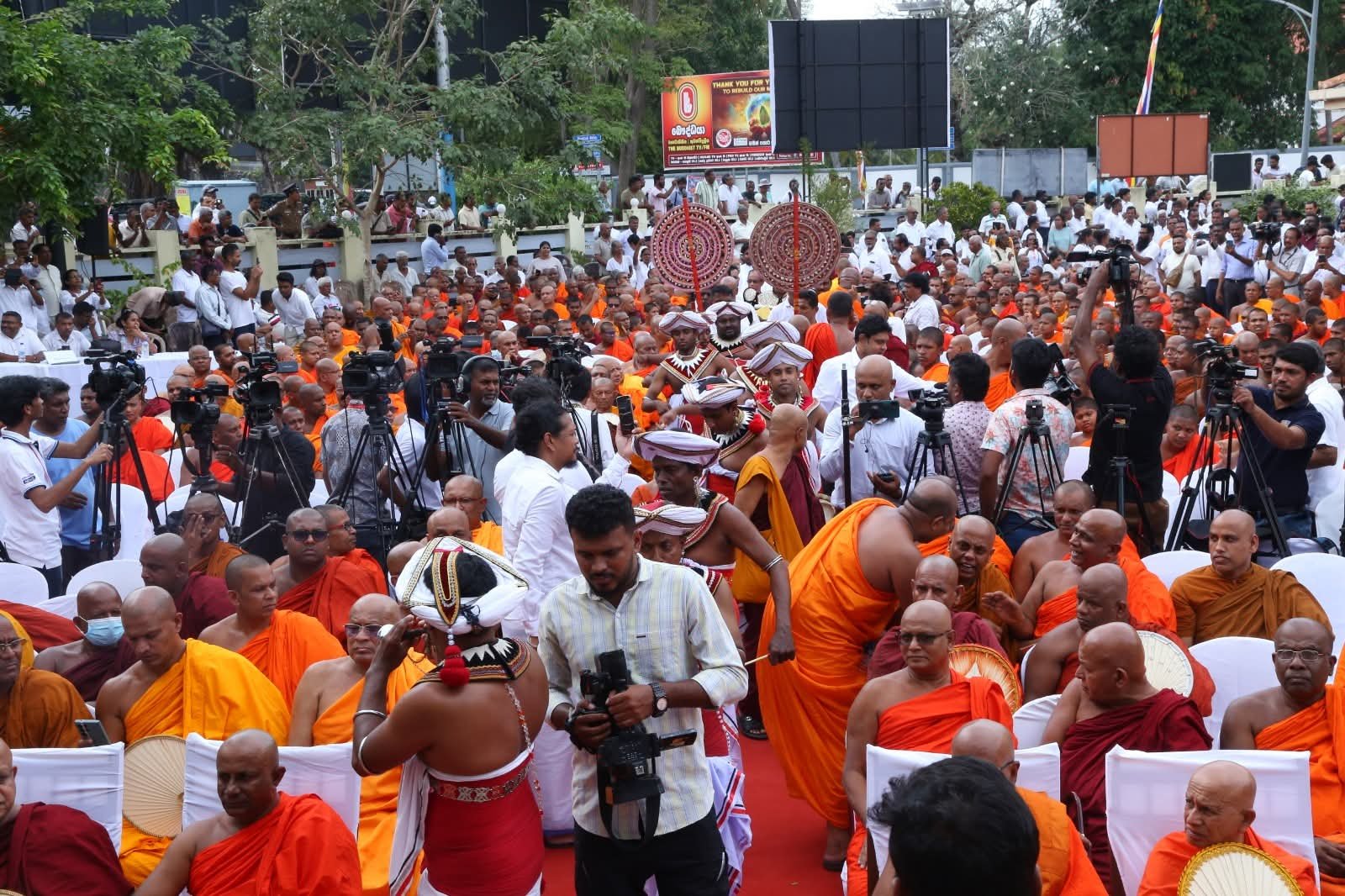
After the Maha Sangha Conference, the voices of civilizational guardianship were raised clearly against separatism and falsehood. Yet even in the aftermath, fake Tamil diaspora leaders continued their rhetoric, speaking of “Sinhalization” as if the presence of Buddhist temples in the North and East were colonization. These words are not truth; they are violations against history and against the civilizational continuity of the island. The chronicles record ancient viharas and stupas in those lands long before separatist myths were invented. Mahiyangana, Thuparama, Ruwanwelisaya, and countless other shrines testify that the North and East were never alien territories but integral parts of the Sasana’s guardianship. Sinhala Buddhists are not colonizers; they are heirs to a civilizational trust that has lasted for over 2,570 years.
The diaspora’s rhetoric of “Sinhalization” is a deliberate distortion, designed to erase the memory of kings who consecrated the island to the Buddha, monks who carried the Dhamma across regions, and people who built temples as acts of devotion. To call this colonization is to deny the Mahavamsa, the Culavamsa, and the Dipavamsa, which record the offering of Lanka to the Sasana. It is to deny archaeology, which proves the presence of Buddhist shrines in the North and East centuries before separatist politics. It is to deny sacrifice, for monks and laypeople alike defended these lands against invasions and terror. Therefore, the Sangha must reject these falsehoods with clarity and strength. The Maha Sangha Conference has already declared unity, and this proclamation stands as the eternal answer: Sri Lanka is one, indivisible, consecrated to the Sasana. No rhetoric of “Sinhalization,” no lobbying in foreign capitals, no Trojan horse politics can override this civilizational truth. The Constitution is the shield, the Sangha is the guardian, and the people are the heirs. This is the eternal duty, reaffirmed after the Maha Sangha Conference and carried forward into the future.
Venerable Maha Sangha, your proclamation has reaffirmed the civilizational guardianship of the Sasana and the unity of our nation. To ensure that this truth is not only spiritual but also legally unassailable, it must be harmonized with the supreme law of the Republic. Article 9 of the Constitution is eternal, enshrining the duty of the State to protect and foster the Buddha Sasana. Article 2 declares Sri Lanka a Unitary State, indivisible and sovereign. These provisions are not mere clauses; they are the constitutional covenant that shields the nation. When the civilizational truth of the Sangha is joined with the constitutional authority vested in Articles 9 and 2, no falsehood, no separatist rhetoric, and no distortion of history can lawfully overcome the sovereignty, unity, and indivisibility of Sri Lanka.
This island, once called Lanka, known as Sinhale, later called Ceylon by colonial powers, is not a mere territory. It is the sacred land chosen by the Buddhas, consecrated by kings, protected by monks, and defended by the people. Its civilizational uniqueness is eternal.
By Palitha Ariyarathna