

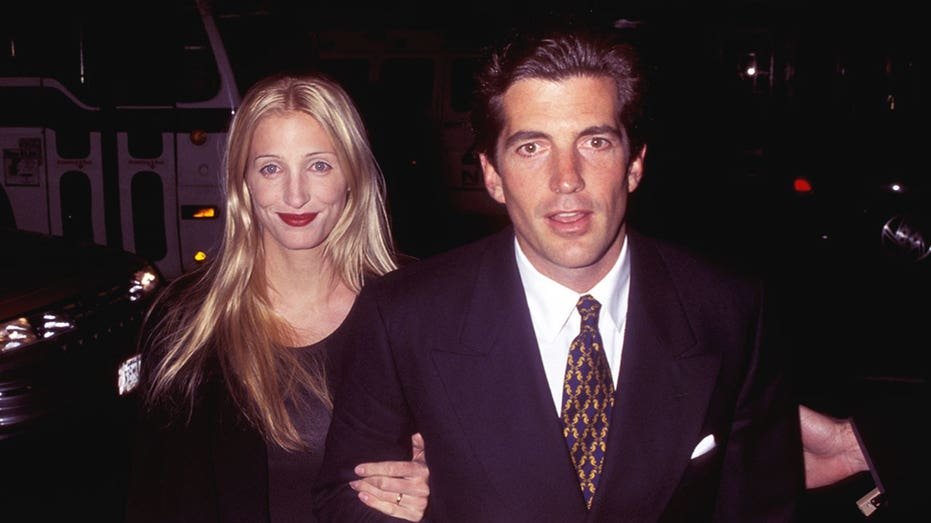
In the agonizing days following the 1999 plane crash that killed John F. Kennedy Jr., his wife Carolyn Bessette Kennedy and her sister Lauren Bessette, Sen. Ted Kennedy issued a strict, emotional mandate to the federal crews racing to recover their bodies: All three would be brought to the surface together.
Retired U.S. Coast Guard Capt. W. Russell Webster, who spearheaded the search efforts, co-wrote “The Last Flight” with his wife, maritime historian Theresa Mitchell Webster. The book chronicles the massive recovery mission after Kennedy’s single-engine plane crashed into the Atlantic Ocean off Martha’s Vineyard.
Navy divers recovered all three bodies on July 21, 1999 — five days after the plane went down off Martha’s Vineyard.
LAST PERSON TO SEE JFK JR. ALIVE REVEALS CHILLING PREMONITION ABOUT HIS FATAL FLIGHT THAT NIGHT
“It became more complicated to ensure that his family’s wishes were followed,” Webster told Fox News Digital about the senator. “It was complicated because, normally, when bodies are recovered, they’re recovered individually. He insisted that his nephew not be recovered as a priority. That was difficult, not only during the later body recovery, but also very early on when John F. Kennedy Jr. was found outside the airplane.”
Fox News may be compensated for or earn a commission if you buy through our referral links.
“There was a sense of urgency, driven primarily by the family doctor to have the divers go back down and retrieve him,” said Webster.
In the book, Webster wrote, “Senator Kennedy was adamant that Navy divers bring up John, Carolyn and Lauren at the exact same time in a single salvage basket. Even though his staffers initially pushed for JFK Jr. to be raised first because his body was outside the wreckage while the women were trapped inside, the senator insisted they be recovered together, so his nephew would not be perceived as receiving special treatment, even in death.”
WATCH: JOHN F. KENNEDY JR. RECOVERY COMMANDER RECOUNTS 5-DAY SEARCH MISSION
Webster wrote that the divers were racing against time. “Walking the Atlantic floor stirs up silt, further compromising low visibility,” he wrote.
The divers quickly found Kennedy’s Piper Saratoga. There was no roof on the plane, and the windows were missing, “having been blown out from the impact.” Kennedy Jr. was on his side on the ocean floor near the wreckage.
“Senator Kennedy insisted that the bodies be raised together at the same time,” Mitchell Webster told Fox News Digital. “So, the Navy on the USS Grasp, has what’s called a basket. It’s a large metal piece with sides for the divers to hang onto. The platform on which they stood in that basket was large enough for them to put three bodies on it. So, they were raised together, and no preferential treatment was shown to JFK Jr.”
“His uncle, from what we’ve been told and from what Russ had observed, was extremely respectful of the process and extremely grateful, as was his family, to the people doing the work.”
The Bessette sisters were found together inside the upside-down fuselage, still strapped into their seats.
The book describes Kennedy as a constant, protective presence who remained beside his nephew and the Bessette sisters. Once the remains were transferred onto a 55-foot Coast Guard vessel, Kennedy and his sons boarded with them. During the transit, as a Navy chaplain quietly administered the sacrament of anointing, the senator invited the Coast Guard crew to join his family in prayer.
GET ENTERTAINMENT SCOOP DELIVERED RIGHT TO YOUR EMAIL BY CLICKING HERE
When the boat reached shore, Kennedy overruled an aide who wanted to delay unloading until more relatives arrived. He insisted the caskets be brought straight to the waiting hearses. He stepped in to help carry them.
“He obviously never left their sides,” said Webster. “After everything was done, he and his wife visited my command at Woods Hole and recognized everybody. He took pictures with everybody, gave out cookies and brownies. It was a very human experience.”
In retrieving the bodies, the crew wasn’t just worried about beating the elements. There were also potential looters. Webster said they were driven by a very real fear that “treasure hunters” or commercial fishermen would stumble upon the wreckage first and steal personal items to profit off the tragedy.
“I think it certainly was a motivation, the potential for not only treasure hunters, but also for fishermen,” said Webster. “This was an active fishing area, and we knew we were driven by the fact, not only by the priority given to us, but also with the knowledge that leaving the wreckage and leaving the victims behind was an unacceptable outcome.”
It was one fisherman in those active waters who unknowingly became a key witness to the tragedy.
LIKE WHAT YOU’RE READING? CLICK HERE FOR MORE ENTERTAINMENT NEWS
Just before 9:40pm on July 16, 1999, Pittsburgh attorney Victor Pribanic was casting his line for striped bass off Squibnocket Point on the southwestern tip of Martha’s Vineyard. A loud, jarring sound echoed across the dark Atlantic. He turned toward the open ocean, saw nothing in the haze and went back to fishing. Pribanic was unaware that he had just heard the final moments of Kennedy’s plane.
“It wasn’t an explosion. It was a boom,” said Webster. “The impact was grave, and it was severe. They likely just went down 116 feet.”
Looking back, Webster said he was proud of his crew’s commitment to duty in retrieving Kennedy’s beloved nephew and his family, even as a heavy sadness settled over everyone involved.
“I remember feeling exhaustion,” said Webster. “I believe I had just laid down for no more than an hour after not sleeping since I got the original call. It was a mixed feeling, a feeling of profound grief and a feeling of profound happiness.
“I worked with a number of families that we could never save their loved ones or find their remains so that they could celebrate their lives in ceremonies. For me, it was a dichotomy of feelings. One was, ‘Oh my God, we found them as a team.’ And the other was, ‘Yes, they’re really dead.'”
WATCH: AVIATION EXPERT EXPLAINS JFK JR.’S FINAL FLIGHT RISKS
Ultimately, the National Transportation Safety Board determined the crash was caused by spatial disorientation. Though Kennedy Jr. had recently passed his written instrument exam, he was not yet certified to fly solely using his cockpit instruments. Just weeks before the crash, a certified flight instructor had noted in his record that he was not ready for instrument conditions.
“What was clear to me was that in those final miles, he had transitioned into an instrument-rated flight that he was not prepared for,” Webster said.
PUT YOUR ENTERTAINMENT KNOWLEDGE TO THE TEST AND SEE HOW YOU SCORE
Even for fully qualified pilots, it can take up to 35 seconds to recover from spatial disorientation, Webster said. It’s a critical window Kennedy Jr. didn’t have once the plane began its steep descent.
“He had to have been anguished, confused, just frightened,” said Mitchell Webster. “It must have been very difficult.”
On July 22, 1999, the families scattered the ashes of Kennedy Jr. and the Bessette sisters in the Atlantic Ocean off the coast of Martha’s Vineyard.
“Not a day had gone by during our research and writing that we did not consider the three victims,” Webster said.
Latest & Breaking News on Fox News