

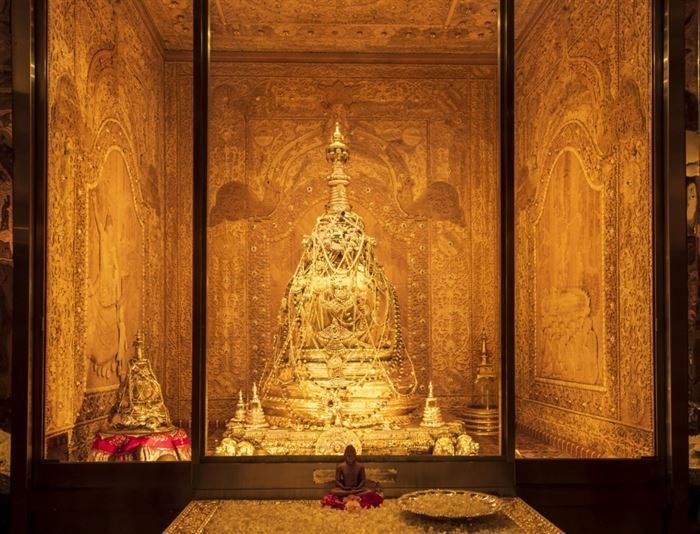
The Sacred Tooth Relic (Sri Dalada) is Sri Lanka’s most revered symbol of sovereignty and the Buddha Sasana, safeguarded for centuries through sacrifice, devotion, and law. From Princess Hemamali and Prince Dantha’s arrival with the Sacred Tooth Relic to its present custodianship in the Temple of the Tooth, the Dalada has always been safeguarded as a collective national treasure. Custodianship was never a matter of private lineage, family lines, or personal claim, but the result of sacrifice by Sinhala Buddhists, the guardianship of the Maha Sangha, and the statutory responsibility of the Sri Lankan State under law. Protected by multiple layers of legislation and the Constitution, the Relic remains entirely beyond the reach of fraudulent ownership claims, enshrined permanently as the nation’s most sacred heritage.
No individual, family, clan, or external institution has ever been lawfully recognized as the owner of the Sacred Tooth Relic. Princess Hemamali and Prince Dantha carried the Sacred Tooth Relic from Kalinga, India. Their historical role was strictly that of guardians and envoys, not owners. They delivered it directly to King Kithsirimevan in Anuradhapura, where it was immediately enshrined as a public symbol of state sovereignty. From Anuradhapura onwards, the Relic was safeguarded by successive kings as the very foundation of state legitimacy. It moved dynamically with each capital: Polonnaruwa, Dambadeniya, Yapahuwa, Kurunegala, Kotte, and Gampola. Custodianship was always tied directly to the throne, never to private families or individual clans. King Vimaladharmasuriya I enshrined the Relic in Kandy in 1595 and successive Kandyan kings protected it until 1815. Under the Kandyan Convention of 1815, the state’s duty to maintain and protect the Buddha Sasana and its sacred rites was officially recognized. The Relic became completely inseparable from the protection of the land and the Sasana.
After the Kandyan Kingdom ended, the Relic remained in Kandy under an unbroken system of public trust. Custodianship passed formally to the Temple of the Tooth, under the spiritual guardianship of the Mahanayake Theros of the Malwatta and Asgiriya Chapters, and the lay custodianship of the Diyawadana Nilame. This remains completely unchanged to the present day. The annual Dalada Perahera in Kandy continues to demonstrate this unbroken custodianship, where the Relic is honored by the Sangha, the people, and the State together. Sri Lanka’s traditional social structures and cultural duties exist entirely to protect and serve the Sasana, not to empower individuals to claim supremacy. All citizens stand equal under the law, and no traditional clan holds superior legal standing over state-regulated heritage. Therefore, any attempt to assert personal, familial, or clan ownership of the Relic is fraudulent, punishable under law, and entirely void against the sovereignty of the State and the authority of the Sasana.
The Sacred Tooth Relic is safeguarded under multiple, strict layers of Sri Lankan law, starting with the Buddhist Temporalities Ordinance (No. 19 of 1931). This explicit statute vests the legal custody, management, and property of the Sri Dalada Maligawa strictly in the Diyawadana Nilame and the Mahanayake Theros of the Malwatta and Asgiriya Chapters, completely excluding private, hereditary, or family lineage claims. Furthermore, the Antiquities Ordinance (No. 9 of 1940) declares the Relic and its shrines as state-protected heritage, making any false claim of ownership, forged certificate, or fabricated historical document a serious criminal offense. Finally, Article 9 of the Constitution of Sri Lanka explicitly mandates that the Republic shall give to Buddhism the foremost place and that it shall be the duty of the State to protect and foster the Buddha Sasana. Together, these laws ensure that the Sacred Tooth Relic remains under the lawful custodianship of the Temple of the Tooth, the Mahanayake Theros, and the Diyawadana Nilame, completely beyond the reach of any private or fraudulent claims.
Custodianship of the Sacred Tooth Relic is not automatically granted by heritage lineage. It has been preserved through the sacrifice of countless Sinhala Buddhists who gave their lives to protect it, and by those who continue to offer their dedicated service to safeguard the Buddha Sasana. Lineage of Paramparā does not grant any single right to claim ownership of the Sri Dalada Whanse. True Sasana Palaka are the monks and guardians who have sacrificed their lives to protect the Buddha Sasana, and their Anurakshanaya (preservation and protection) of the Relic stands permanently above any clan or family line, enduring forever. The Sri Lankan Government also bears strict responsibility under Article 9 of the Constitution to protect the Relic and the Sasana, ensuring its survival for future generations.
When fringe individuals and deceptive social media groups manufacture a false sense of legitimacy by proclaiming, “I am going to court against my critics,” it is a psychological trick designed to trap unsuspecting followers into thinking, “Well, if he is willing to go before a judge, his claims must be true.” The reality of Sri Lankan civil procedure is completely the opposite. Talk is free on social media, but a court of law strictly rejects fictional royal titles, self-invented lineages, and fabricated charts. If any individual wishes to assert an alternative Dalada Wahansé Barakarathwaya, the burden is entirely on them to first enter a legitimate courtroom, prove their case under oath against established statutory laws, and obtain a valid judgment before addressing the public community. They cannot do this because the law is clear: Article 9 of the Constitution, the Buddhist Temporalities Ordinance, and the Antiquities Ordinance vest exclusive custody solely in the public trust of the State, the Mahanayake Theros, and the elected Diyawadana Nilame. Any frivolous petition filed to legitimize an online hoax will be thrown out of court immediately. Furthermore, the petitioner risks being heavily fined for filing false, malicious, and vexatious litigations. If these deceptive social media campaigns escalate into actual interference with national heritage or widespread public deception, the state legal advisory and law enforcement authorities possess full authority to launch immediate criminal investigations, leading to swift arrest and prosecution under the Penal Code.
Let it be known with absolute severity: playing with the legacy of the Buddha Sasana is playing with fire. Moving day by day, year by year, from simple civil defamation into the calculated incitement of religious hatred and mass public deception is a direct violation of national security. Sri Lanka’s highest intelligence commands, the Criminal Investigation Department (CID), and state law enforcement authorities hold unyielding statutory power to treat any digital or physical threat to the Sri Dalada Maligawa as a critical national emergency. Under Article 9 of the Constitution, the government is bound by an unyielding duty to protect the Buddha Sasana from subversion. Those who cross this line will be treated not as mere internet commentators, but as active extremists committing acts of ideological sabotage against the Republic. They face immediate state surveillance, aggressive anti-terror crackdowns, and an uncompromising criminal prosecution under the strictest laws of the Republic leading to swift state arrest and a guaranteed path to severe prison sentences. From Princess Hemamali’s arrival to today’s Temple of the Tooth, the Sacred Tooth Relic has always been a matter of state sovereignty and Sasana protection. No individual, clan, or fabricated paper, fabricated claim can override this unbroken custodianship safeguarded by law, history, sacrifice, and tradition.
When we look around the globe for cases similar to what is happening in Sri Lanka, we can find several parallels showing how law and international enforcement have treated such threats. Global history and modern law enforcement show that individuals fabricating “royal bloodlines” or fake histories to steal public trust or run online scams are prosecuted with extreme severity. When fringe groups use social media to manufacture history, create fake certificates, or undermine ancient public heritage, state law enforcement authorities classify it as fraud, cultural sabotage, and subversive exploitation. The following parallel international cases demonstrate how global courts and state security agencies ruthlessly dismantle these exact hoaxes to protect national sovereignty and public heritage:
In Spain, organized networks systematically looted historical Roman and Iberian archaeological sites, and instead of hiding in the shadows, these groups used social media platforms like Facebook and YouTube to publicize their findings, forge false documentations, and directly sell historically protected state antiquities to unsuspecting citizens. In a massive international sting operation, law enforcement authorities arrested the perpetrators, seized thousands of illegally claimed coins and artifacts, and shut down their digital networks. The courts ruled that using social media to fabricate a private trade or claim authority over state-protected historical assets is a direct violation of national security and cultural heritage preservation laws.
A landmark international trial at the International Criminal Court (ICC) vs. Ahmad Al Mahdi established how the law treats individuals who target highly venerated, sacred religious landmarks to cause public division. Al Mahdi led a fringe extremist group that intentionally attacked, vandalized, and claimed authority over ancient sacred mausoleums and the Sidi Yahia mosque in Timbuktu, claiming his group held the “true religious authority” to dictate the fate of these sacred monuments. The International Criminal Court made global history by prosecuting this act not as a simple property dispute, but as a war crime against cultural heritage. Al Mahdi was arrested, stripped of his perceived authority, and sentenced to 9 years in prison, with the court ruling that targeting heritage held sacred by a community inflicts immense psychological and spiritual harm on an entire nation.
Across Europe and Asia, law enforcement agencies regularly target con artists who attempt to construct fraudulent identities by styling themselves as “princes,” “royal envoys,” or “rightful ancestral heirs” to ancient dynasties. Those who fabricate elaborate family trees, present falsified certificates of lineage, or use pseudo-royal titles to deceive the public are subject to criminal prosecution under penal codes governing Cheating by Impersonation and Forged Documentation. When specialized investigative bodies—such as Sri Lanka’s Criminal Investigation Department (CID) or financial intelligence networks—track these unauthorized activities, perpetrators face imminent state intervention. Under anti-money laundering and fraud statutes, such operations risk swift asset freezes, the legal confiscation of all forged materials, and severe criminal prosecution carrying maximum prison sentences for exploiting public trust.
In global interventions against history falsification, countries like Greece and Egypt immediately flag individuals who attempt to overwrite orthodox national history or fabricate alternative localized birthplaces of major historical figures to build cult-like followings. When these claims threaten to cause massive civil unrest, fuel religious hatred, or damage international diplomatic relations, state intelligence units step in. National security protocols allow states to aggressively shut down alternative publishers, ban malicious literature, and prosecute the orchestrators under state subversion laws. The law recognizes that falsifying ancient history is a deliberate tool used by extremists to destabilize state sovereignty.
This identical layer of state enforcement and national security prosecution must also be strictly applied to individuals and groups spreading the dangerous pseudo-historical heresy claiming that Gautama Buddha was born in Sri Lanka. Just as the state actively crushes false claims to the Sri Dalada, it holds an identical constitutional mandate to stop this deliberate distortion of Buddhist history. This myth maliciously erodes the historical integrity of Theravada Buddhism, undermines archaeological reality, and creates mass confusion within the global Sasana. To dissolve this issue immediately, the Government of Sri Lanka must act directly under Article 9 of the Constitution. The state must officially institute rigid guidance and direction from the Maha Sangha Advisory Board and the Supreme Council of Nikayas. This ecclesiastical guidance must drive the immediate formation of a Constitutional National Buddhist Heritage Commission tasked with systematically banning malicious literature, pulling down fraudulent historical pages, and enforcing the absolute historical truth of the Tripiṭaka. Anyone continuing to maliciously propagate this heresy day by day, defying the authority of the Maha Sangha and state sovereignty, will be met with immediate state security crackdowns and criminal prosecution for inciting public religious unrest.
Sri Lankan law organisations including the state legal advisory and law enforcement authorities, the Department of Archaeology, and the Ministry of Buddhasasana must remain highly vigilant. Any attempt by individuals, families, or clans to assert personal ownership over the Sacred Tooth Relic, or distort Buddhist history, should be treated as a criminal act. Swift investigations, warnings, and prosecutions must be executed to protect national sovereignty, constitutional mandates under Article 9, and the permanent security of the Sasana.
Primary Legal & Historical References
- The Constitution of Sri Lanka (1978) – Article 9 (Mandates the State’s duty to protect and foster the Buddha Sasana against subversion).
- Buddhist Temporalities Ordinance No. 19 of 1931 – Section 7 (Vests exclusive legal custody of the Relic in the Diyawadana Nilame and the Mahanayake Theros of Malwatta and Asgiriya).
- Antiquities Ordinance No. 9 of 1940 – Sections 2, 15D, & 48 (Declares the Relic a state-protected antiquity and deems fake certificates or private ownership claims a criminal offense).
- The Kandyan Convention (1815) – Clause 5 (Historically established that custody of the Tooth Relic is an official state protection function, not a private one).
- The Mahavamsa & Dalada Siritha – Ancient chronicles verifying that Princess Hemamali and Prince Dantha were strictly royal envoys who delivered the Relic to the State at Anuradhapura.
- Punya Ekanayaka Research Index (“Wanni Raja Daruwo Hewath Bodhiguptha Parapura”) – Historical analysis tracking the operational boundaries of lay service structures, clearly defining them as duties to the Sasana rather than private ownership vectors. [1, 2]
- The Penal Code of Sri Lanka – Sections 399 & 452 (Criminalizes fraud, cheating by impersonation, and the forgery of fake lineage titles or historical documents).
- National Security & Computer Crimes Frameworks (Computer Crimes Act No. 24 of 2007) – Legal basis for prosecuting Ideological Terrorism, Cultural Sabotage, and Subversive Extremism where digital networks are used to incite religious hatred, spread mass public deception, and undermine state sovereignty.
Authenticator’s Note: This article is written in an authenticator’s voice to ensure accuracy and legitimacy, reflecting verified history, constitutional law (specifically Article 9), specific ordinances, and the collective sacrifice that safeguards the Sacred Tooth Relic and Buddhist heritage.
Legal Notice & Statutory Disclaimer
This publication provides independent historical and academic analysis of Sri Lankan law. It does not constitute formal legal advice, a professional opinion, or a judicial ruling, and establishes no attorney-client relationship. All legal enforcement and punishments rest exclusively with the courts and state authorities of Sri Lanka. The author disclaims all liability for any third-party use, citation, or misinterpretation of this document.